

Five ways to improve marketing in 2026 for community college
The world is changing in 2026. Politics are divisive, the economy is in flux, the AI bubble is expected to burst, and international affairs are constantly changing. In this year of change, here are five ways to improve marketing at community colleges.
1. Focus messaging around “low tuition”
Student debt is crippling some recent graduates, and today’s incoming students and their parents have the goal of graduation without a mountain of student loans. The average student loan debt at graduation is $39,075 per borrower (Education Data Initiative)
Google searches for the term “scholarships” have been declining since 2014 while searches for “tuition” have been increasing over the same period. As expected, this search drops at the beginning of summer and the beginning of fall – at times when students are not thinking about tuition while either beginning a summer vacation or focusing on classes.
Actions: Do SEO and ads around the word “Tuition”.
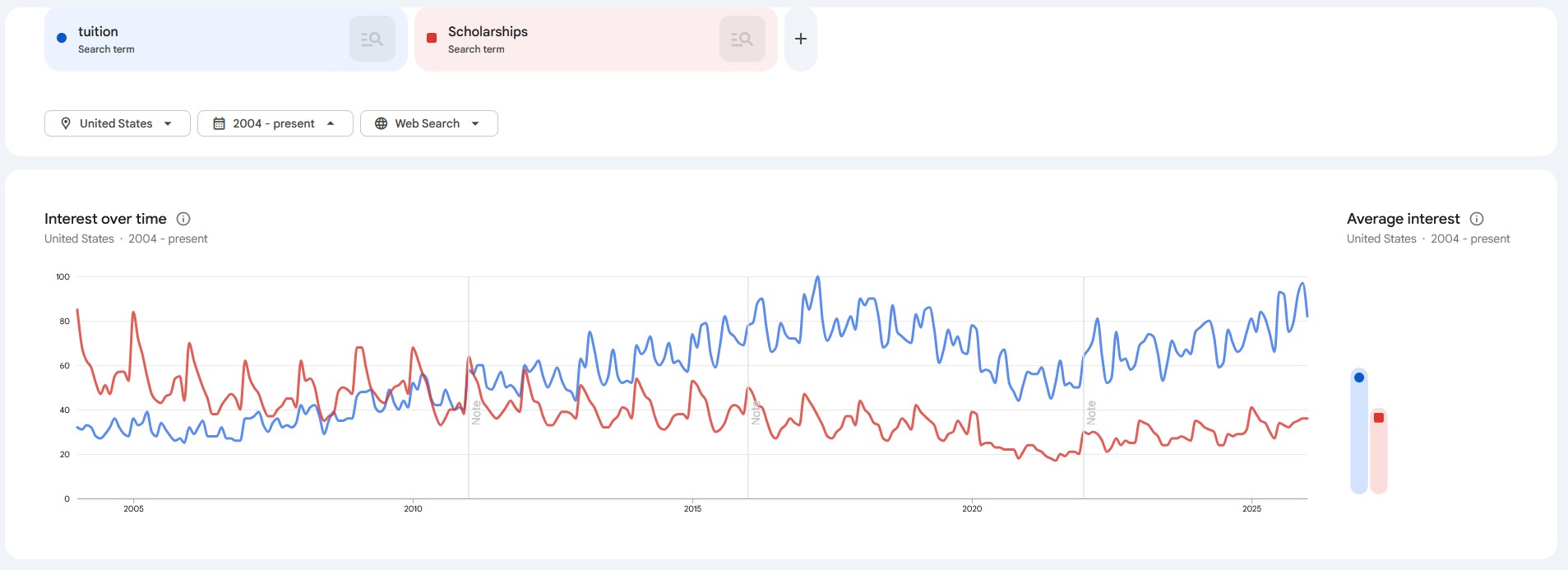
Google trends: “Tuition” vs “Scholarships”
2. Have a solid plan on Social Media
How to market to high school students? Get in front of their eyeballs. High school students are on social media. According to the Pew Research Center (source), the top social media platforms for high school students with the percent of students who use each are:
- YouTube – 90%
- TikTok – 63%
- Instagram – 61%
- Snapchat – 55%
- Facebook – 35%
- WhatsApp – 23%
- X / Twitter – 17%
- Reddit – 14%
A social media strategy will have the same branding and similar messaging across multiple platforms. Post at least once a week to look active. Better yet, post on the same date and about the same time so the algorithm knows when to expect it and promote it.
Actions: Create a social-media calendar for weekly posts on at least two platforms.
3. Win at student experience
We worked with a school that said its biggest benefit was its low tuition. This is great, but the problem was the tuition schedule was buried on the website. When challenged to find the tuition, its own marketing team took 15 minutes to find the tuition on a downloadable PDF. It wasn’t even listed on the website!
Put yourself in a student’s shoes and go through your website and materials. Or bring together a focus group for them to give feedback. When in doubt, use a tool like Hotjar to get a heat map of where website visitors click. We used Hotjar on that university’s website and saw the top clicked item was the search icon which told us the menu was not intuitive.
Actions: Evaluate your website and materials for a great student experience
4. Get SEO right to keep traffic high even when budgets are low
Website traffic needs to stay high even when budgets are cut. Overall traffic can be broken down into three types of traffic: direct, paid, organic. SEO impacts organic traffic and is the least expensive and most impactful of the three sources.
Direct traffic is people visiting your website after clicking on a link (usually from an email or document). So if you send out eblasts, newsletters, or mail merge.
Paid traffic is traffic that goes to your website through paid ads and searches. These are paid ads on Google, YouTube, and social media.
Organic traffic is traffic made when someone searches on Google and your site shows up on the organic results.
Actions: Run an SEO evaluation on your key pages and get them optimized on key search terms.
5. Market to international students from the local universities
International economies, relations, and policies are very unstable. The UAE recently announced it will pause all funding of its students studying in the UK out of fear of students being approached by terrorist organizations (source). These students are able to secure a visa and want to study where they can study in English. US universities too are seeing students out of Africa and Asia explore lower-cost options as their currency weakens against the dollar.
Actions: Have a landing page for international students with cost and transfer agreements